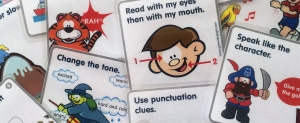
Reading with Expression Cards

Reading with Va-Va-Vooooom

No more monotone! Use this phenomenal resource to get your students reading with expression.
How many times have you told a young reader to read with more expression, only to have the child look at you strangely? We’ve all said that to children with the same result; dull, robotic reading of potentially exciting texts.

Jo-Anne Dooner, co-founder of our program had the same problem, but she found the answer to help children give their reading that va-va-voooooom, designing our Reading with Expression Cards.

“My students had moved on to series 3 of the Practice Books, which had them using their decoding skills to read a sentence with expression. I kept asking myself, how do I teach and assess reading with expression?

One evening while planning for guided reading, I sat and analysed exactly how we read with expression: my dutiful daughter listened to me read and told me what I was doing to make the text more exciting. These strategies formed the basis of our Reading with Expression Cards.

After using the cards a few times the children came up with some strategies too!”

What You Need:

Read more from our blog!

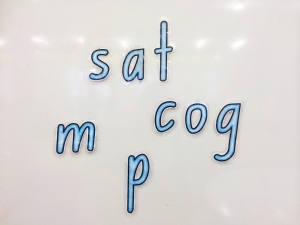
DIY Giant Magnetic Letters

On a recent trip down to the Gippsland, we were lucky enough to be welcomed into Sally Hedrick’s classroom at Warragul North Primary School… and WOW what a classroom! Among her fabulous displays, was a resource that we simply had to share – DIY Giant Magnetic Letters!

You will often demonstrate to your whole class how to blend and segment with magnetic letters, and to do so you need to be working with larger graphemes. This simple four step resource is just what you need.

Instructions:

HINT! Print on coloured paper e.g. blue, to make them brighter.

  • Cut out letters individually and laminate
  • Using a strip of magnetic tape, cut around 40 small 1cm pieces

NOTE: You can buy the tape at your local Officeworks. Or even better, have you been given any useless promotional magnets lately? Save yourself some money and use those instead of the tape!

  • Superglue one magnet square (or two depending on the size of the grapheme) onto the back of each grapheme

Check out what they look like in action above! Once again, thanks a bunch Sally for letting us use your wonderful idea!

Read more from our blog!

Football Phonics Game

Score some phonics goals and cheer on your team in the World Cup, while reinforcing the different spelling representations of each vowel phoneme.

Set up

  • Print Football Phonics Template
  • Photocopy one goal per spelling representation e.g. ‘e’, ‘ee’, ‘ea’, ‘y’, ‘e_e’ = 5
  • Photocopy one sheet of soccer ball cards per child
  • Cut out ball cards individually
  • Write one target spelling representation on each goal e.g. ‘ea’
  • Write corresponding words on each ball card e.g. ‘beach’ (you can use the word lists from the Toolkit)
  • Have the children sit in small groups with various goals in the centre of each group
  • Additionally, you will need around 50 tokens per group

N.B. If you intend to re-use the goals and cards, laminate them after printing, and use a whiteboard marker to write on them.

How to play

  • Deal each child 15 soccer ball cards (one whole set) with the words facing down.
  • The player to the dealer’s left starts. Have the child flip over his or her first card revealing a word.
  • Have the child read the word aloud.
  • Ask the child to place the card on the correct goal.
  • If the child chooses the correct goal, he or she will receive one token.
  • If the child chooses the incorrect goal, have him or her read the word again and try again.
  • The child to the left of the player then takes a turn, following the same steps.
  • Once all of the cards are on goals, the player who has the most tokens wins!

To make it harder, get the children to write their own words using the target spelling representations. See who can score the most goals!

Read more from our blog!

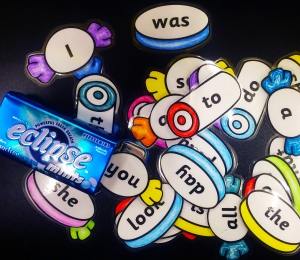
Camera Word Mints

Try this funky resource that will take you less than five steps to make.

Simply print, laminate and cut out!

Do you have a million and one mint tins lying around? I bet if you took a good look at the bottom of your handbag, through the car glovebox, and through all those desk drawers there would be a fair few.

Here’s an idea to create a fabulous phonics resource using those cute little tins. It’ll make sending camera words home a whole lot more fun!

Trust us… It’s ‘mint’…

Instructions:

  • Print Camera Word Mints Template
  • Photocopy one set per child
  • Cut out individually and laminate
  • Place the desired unit of camera words in the tin
  • SEND HOME!

Yep, it’s as easy as that!

NOTE: Print or photocopy some mints on various shades of paper to mix things up a bit.

Read more from our blog!

Free Resource: Easter Bingo Game

This game is a fabulous way to reinforce phoneme-grapheme recognition!

Set up

  • Download the Easter Bingo Boards
  • Write on relevant phoneme representations/words from the target unit (sample bingo boards are available in Parts One, Two and Three of Synthetic Phonics Toolkits!)
  • Seat children in groups of six around a table
  • Each child will need a dozen tokens

How to play

  • Give each child an Easter Bingo Board.
  • Say a phoneme/word. Ask children to place a counter on the corresponding grapheme/word.
  • Continue with more phonemes/words until a child covers every Easter egg on his board.
  • The child who covers all the Easter eggs first shouts “Chocolate!”

To make the game harder, play using camera words.

Fun Tip: Give children real chocolate Easter eggs to use as counters on their Easter Bingo Boards!

Read more from our blog!

Word Train Game

This game is a fantastic way to practise reading and spelling words. It’s also a great way to reinforce phoneme-grapheme recognition.

Set up

  • Print Train and Carriage Template
  • Photocopy one engine per child and five carriages per child
  • Cut out individually and laminate
  • Use a whiteboard marker to write one target grapheme on each carriage
  • Have the children sit in small groups with a hula-hoop in the centre of each group
  • You will need around 20 tokens per group
  • N.B. make sure you have more vowels than consonants

How to play

  • The dealer gives an engine and three carriages to each child. The remaining carriages are placed face down inside the hula-hoop.
  • The player to the dealer’s left starts. Have the child make a word with his or her carriages. If the child cannot make a word, turn a carriage over in the centre of the hoop to reveal a grapheme.
  • Ask the child again if a word can be made by swapping one of his or her carriages for the revealed grapheme carriage.
  • If the child chooses to swap a carriage to make a word, they must place the unwanted carriage face down in the hula-hoop.
  • He/she earns one token for making a word, and the child to the left takes a turn, following the same steps.
  • If the child cannot make a word with their new carriage grapheme, it is turned back over and no token is earned.
  • The player who has the most tokens wins.

To make the game harder, write a camera word on the long carriage, and have children make captions to earn a token, or add an extra carriage allowing them to make longer words.

Read more from our blog!