Get Reading Right Scope and Sequence
A well-crafted phonics scope and sequence is at the heart of effective reading instruction. Here’s how the Get Reading Right sequence aligns with curriculum requirements — including the NSW K-2 English Syllabus.
Download the Updated Scope and Sequence
Get Reading Right Synthetic Phonics Scope and Sequence — NSW K-2 Syllabus (PDF)
This document maps the Get Reading Right sequence to the NSW English K-2 syllabus outcomes, content descriptors, and progressions. Continue reading below for a walkthrough of how it all connects.
No Sequence Is Superior — But Fidelity Matters
The NSW English K-2 syllabus has a solid evidence base and clearly supports the Science of Reading. One of its key components is a designated section for phonic knowledge, including a suggested sequence of grapheme-phoneme correspondences (GPCs).
So which sequence is the best? The answer was clearly defined in the Rose Report (2006): no sequence is any better than another. What matters is fidelity to a chosen sequence — consistency of practice ensures student success. Many well-known GPC sequences are used across the world, and many publishers of decodable texts use different sequences.
The NSW Syllabus Sequence Is a Suggestion, Not a Mandate
The appendix of the syllabus includes a suggested instructional sequence for schools introducing GPCs for the first time. It is not a mandated sequence. The suggested sequence aligns to the syllabus content — but so can many other GPC sequences, including Get Reading Right’s.

How the GRR Sequence Aligns to the Syllabus
The updated scope and sequence document contains two compliance pages for each grade:
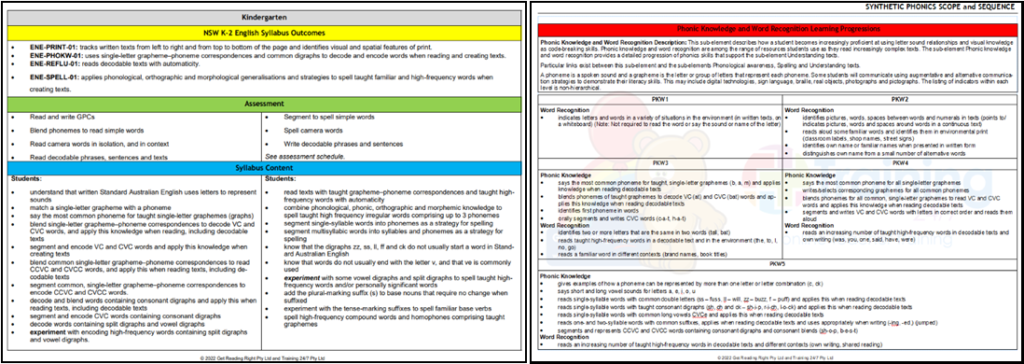
Syllabus Page
Divided into three colour-coded sections:
NSW K-2 English Syllabus Outcomes (yellow) — Mandatory statements denoting mastery at the end of a stage. Includes outcomes for Phonic Knowledge, Print Conventions, Reading Fluency, and Spelling.
Assessment (green) — How the outcomes will be assessed, linking directly to the Progressions page for tracking student achievement.
Syllabus Content (blue) — All descriptors relevant to the outcomes, linked together within the scope and sequence. Content descriptors have always been a guide for what to teach to achieve the outcome.
Progressions Page
Outlines both the sub-element and the indicators within the range of achievement expected for each grade.
After assessment, the descriptors can be used to judge a student’s achievement against a progression marker and identify areas of growth between assessment points.
This is particularly useful when reporting to parents using the mandated A-E grading scale.
The Content Pages
The content page is essentially what to teach throughout the year — the knowledge, skills, and strategies for decoding and encoding words.
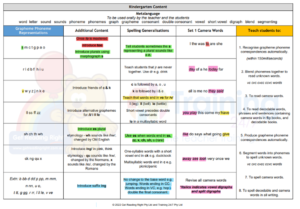
Addressing Specific Syllabus Content
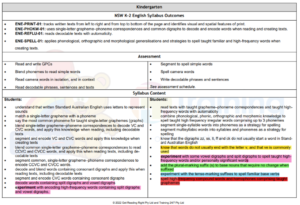
The following targeted descriptors show the link between the syllabus content and the GRR scope and sequence:
Vowel digraphs and split digraphs (pink) — Addressed without changing the sequence by using camera words. While this doesn’t cover all 30+ vowel digraphs or all five split digraphs, it exposes students to the concept that graphemes come in different forms. Mastery continues in Year 1 and Year 2.
Graphemes: v and ve (yellow) — Teach ve in Unit 3, after students have secured v. Show the difference in words that begin and end in this phoneme.
Plural morphographs (green) — Begin teaching plural -s in Unit 1. Introduce -es in Unit 4 alongside ss and zz. Continue into Unit 5 with sh and ch, and Unit 6 with x.
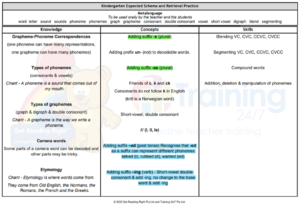
Tense marking suffixes (blue) — Introduce -ed in Unit 3, paying attention to its three different pronunciations. Introduce -ing when students have mastered CVCC verbs, continuing after Unit 4 with doubling the consonant to add the suffix.
High frequency homophones (red) — These occur more frequently in Year 1 when students learn multiple vowel graphemes. To/too is introduced in Unit 1 as to is one of the first camera words taught.
Downloads
NSW K-2 Scope and Sequence
The updated Get Reading Right scope and sequence mapped to the NSW English K-2 syllabus.
General Scope and Sequence
The Get Reading Right phonics scope and sequence for use in any Australian state or internationally.
Want help implementing the scope and sequence in your school?
We recommend completing the Synthetic Phonics Full Day Course at Training 24/7, which includes a draft scope and sequence and over 1,000 classroom resources. Contact our team for guidance.